What Is the Liquid in Baby Teething Rings
 In one of scenes for Lady Chandler's Sister: Book Three of the Twins' Trilogy , a infant belonging to the story'due south heroine is running a slight fever and is fussy. The md summoned to the child's aid suggests a coral for the kid'due south teething needs, but one of my Beta readers wondered if I knew of what I spoke, for her idea of "coral" was marine invertebrates that typically alive in meaty colonies of many identical individual polyps.
During the Regency era, neither the parents nor many of the attending physicians knew much about the teething experience. When my son was small, every time he cutting a tooth, he ended up with an ear infection. I knew something of what worked to ease the pain he experienced, just not so much for parents during the Regency. Many and so-called intelligent adults of the menstruum thought teething was one of the causes of babe deaths, claiming that a child'southward frail nervous system caused the the babe to go into convulsions.
 Even though,Hippocrates: Volume I: Ancient Medicine (Loeb Classical Library, No. 147) [by Hippocrates (W. H. S. Jones, Translator)] said otherwise, the belief continued to exist stated as if information technology were the truth.
Hippocrates wrote


 Because of this fear, a legend, of sorts, grew up around the utilise of a "coral" to save the child'due south pain and to protect him or her from an early expiry. Such an attitude carried into the 20th Century. "Then mortiferous has it become, that one-3rd of the human family dice earlier the twenty deciduous teeth accept fully appeared." [J. D. White, John Hugh McQuillen, George Jacob Ziegler, James William White, Edward Cameron Kirk, Lovick Pierce Anthony, editors. The Dental Cosmos, Book 36, South. Due south. White Dental Manufacturing Company, 1894.]
According to Wikipedia, the "coral" fable finds its roots, quite literally, in Greek mythology and the story of Perseus. In the story, Perseus changed Cetus, the sea-monster into a petrified state by employing the caput of Medusa. Cetus had assisted in Poseidon's revenge and the god'southward property of the Princess Andromeda. Cetus intended to eat Andromeda. Having defeated Medusa, Perseus placed Medusa'due south severed caput upon the riverbank, so he might wash his hands of the claret. When he reclaimed the head as a prize, he noted that Medusa'due south blood had turned the seaweed and the reeds to ruby coral. Thus, the Greek discussion for coral is 'Gorgeia,' every bit Medusa was one of the iii Gorgons. The Romans, who afterwards took up the tale, believed coral could protect children from harm too as cure wounds made by snakes and scorpions and diagnose diseases by changing colour.
"At the first of the 1st millennium, at that place was meaning trade in coral between the Mediterranean and India, where information technology was highly prized as a substance believed to exist endowed with mysterious sacred properties. Pliny the Elder remarks that, before the great demand from India, the Gauls used information technology for the decoration of their weapons and helmets; but by this period, and so great was the Eastern need, that it was very rarely seen even in the regions which produced it. Amidst the Romans, branches of coral were hung effectually children'due south necks to preserve them from danger from the outside, and the substance had many medicinal virtues attributed to it. The belief in coral's potency equally a charm continued throughout the Centre Ages and early in 20th century Italian republic it was worn every bit a protection from the evil eye, and by women as a cure for infertility." (Precious Coral)
Ancient Egyptians believed coral would east the pain of teething. According to author Kathryn Kane at The Regency Redingote, "Though the ancient Egyptians were unaware of the Greek'due south mythological story of the origins of coral, surviving Sumerian tablets more than three yard years old record their use of coral for teething rings. The Egyptians believed the coral would ease their babies' pain during teething and they had these coral rings inscribed with the head of Bes, a god which was known to protect children. Both the ancient Greeks and Romans believed that coral would ward off the falling sickness and a number of other infantile ailments and diseases. Plato wrote, 'Coral is good to be hanged near … ' The Greeks hung coral ornaments on their babies' cradles and in their nurseries while the Romans hung pieces of polished cherry-red coral around the necks of their babies to go on away evil influences. This conventionalities in the supernatural power of coral survived into the Middle Ages in Europe, where coral gum sticks were given to teething babies of the upper classes. Parents believed the coral would ward off evil and forestall their babies' gums from bleeding.
"In Renaissance Italian republic, a skilful-luck amuse made of coral in the shape of a branch of reddish coral was worn by many adults. Such protective charms were even more often placed around the necks of many babies to ward off any evil influences. Curiously, it was as well believed that coral would protect children from lightening strikes. By the sixteenth century, the use of coral to protect babies had spread beyond Europe and a necklace of coral beads had become a common christening souvenir to babies of the more flush classes. Most children wore these coral beads for years. When the necklace became too small to be worn effectually the neck, the bead string was usually doubled and worn as a bracelet until the child became an developed. Some children really chewed on their coral charms or coral chaplet while they were teething."
Although the verbal timing of can vary from kid to child, babies typically brainstorm teething around 6 months of historic period. Ordinarily the front lesser 2 teeth (lower central incisors) emerge showtime, accompanied by the front acme ii teeth (upper central incisors). Teething tin can be a painful and difficult procedure for both babies and parents, as infants may become specially fussy or cranky while their new teeth sally. Quintessential signs and symptoms of teething include irritability or fussiness, drooling, chewing on firm solid objects, and sore or sensitive gums. Parents also commonly conclude that teething causes diarrhea and fever, simply enquiry has shown this to be untrue. Teething does produce signs and symptoms in the gums and mouth merely does not generate ramble or other extended actual symptoms.
Well-pregnant parents and physicians of the 18th and 19th centuries used a variety of cures and remedies, well-nigh of which were dangerous to the children involved, including:
lancing the gums
amulets adorned with magical charms: coral sticks, semiprecious stones, a wolf's molar (Some were placed effectually the neck, merely others were placed around the waist.)
a lump of sugar wrapped in a cloth
a necklace of coral or nine strands of reddish silk
a bag containing wood lice or hairs of a ass placed virtually the neck
a necklace of figwort stems or stale bittersweet berries or peony root or sea beans
stems of elder or traveler'southward joy were similarly made into teething beads
native plants such equally the wild red poppy, besides every bit the imported opium poppy were used topically
leaves of groundsel infused in infant's milk
rubbing the brains of a hare on the gums
a folded over material saturated with brandy or other spirits
placing leeches on the baby's gums to "drain" him or her
Many parents swore past Mrs. Winslow's Soothing Syrup, for example, whose advertisements proclaimed, "Depend on it, Mothers, information technology will give remainder to yourselves and relief and health to your babies." Information technology gave rest merely non health: It was, essentially, a mixture of alcohol and morphine.
A 17th C recipe from Sussex used dried roots of henbane, orpine and vervain, all soaked in booze and dried to form a necklace to chew on.
A ready-made necklace, available commercially for buy, used imported orris to ease the pain.
Sources:
[Hatfield, Gabrielle. Encyclopedia of Folk Medicine: Old Earth and New World Traditions.]
[Day, Nicholas. Morphine? Wolf's Teeth? Hare Brains? The Countless Quest to Solve Teething. Slate.com]
A expect at this list shows the infant mortality charge per unit likely had more to do with the "cures" than the teething process.
At the middle of the 1700s, children of wealthy parents began to seek out a ways to keep their children alive. They mixed in a bit of superstition and a bit of the best science of the times and demanded a popular item of the age: an era pacifier adorned with natural materials, such equally coral or mother of pearl. The shine surface of the coral or the female parent or pearl provided the baby with something to suck and gnaw on and the miniature bells and rattles distracted the child from his teething pain. These "pacifiers" were typically fabricated of sterling silver or gold. Silversmiths of the era made pacifiers and cups, commissioned past the aristocracy. There were many small parts on the typical coral ring, just no ane of the age worried about a choking hazard. The pacifiers were meant to found a person's place in Club, the aforementioned every bit would exist the commissioned tea service from the very aforementioned silversmith. Coral was chosen considering of its long-continuing belief to ward off ailments, and mother of pearl was used to symbolize purity and innocence. [Colonials Indulge Babies with Aureate Pacifiers, Coral Teething Rings]


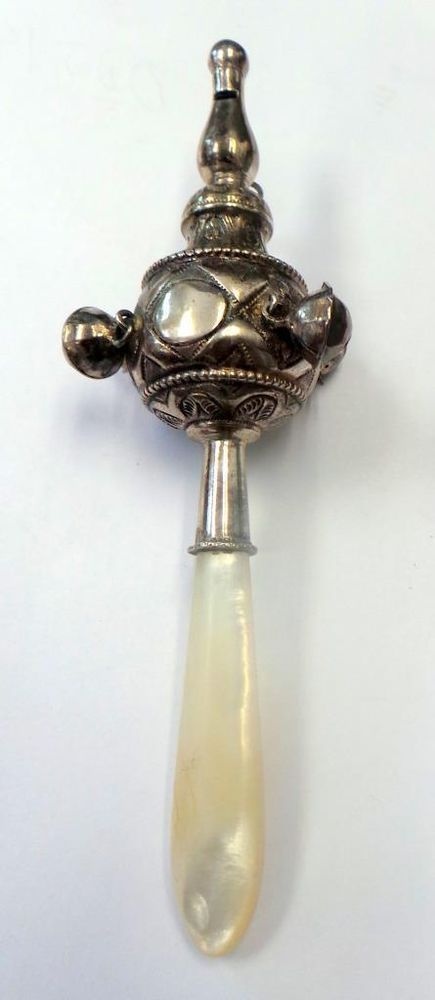

These lavish rattles and pacifiers announced the wealth of the family unit, but they also served as a applied way to salvage the child'due south suffering, for coral is a relatively soft gemstone, while firm, it is more than "forgiving" than the bones and woods and raw carrots those of the lower class depended on. Coral also did not splinter or break. The Victorian era saw the use of the white mother of pearl rattles more so than those fabricated of red coral.
As my story is set at the cease of 1820, soon after George 4 came to the throne, I was item to double cheque the use of the "pacifiers" shown in a higher place, likewise as the word "corals," as I have the medico utilise it in the novel. I discovered that parents of this concluding of the Georgian periods preferred coral gum sticks, which is what Doctor Dalhauser suggests to the story'south heroine.

Source: https://reginajeffers.blog/2018/11/07/a-babys-teething-ring-during-the-regency/
0 Response to "What Is the Liquid in Baby Teething Rings"
Post a Comment